Private Investigators


What do Private Investigators do?
Rockwell Investigator Training is a good start.

Some of the top requested business for a private investigator is:

1. Insurance surveillance – Stationary and mobile surveillance. Many insurance companies have received claims, and apparently, they want to find out if the claim is valid, so they have private investigators follow a client and see if they are unable to work, drive or have a twisted neck or other disabilities.

2. Cyber Intelligence – finding information on a subject such as social media, medical history, any phone calls and the like.

3. Executive Protection – Bodyguards can keep an executive protected, but they are out in the open, and everyone can see them. So the hiring of a private investigator can have people within the crowd lurking with the potential attackers.

4. Interviewing – A type of information may be required from an individual, and they don't want to ask for it as this will be obvious, and the person may lie. So a private investigator can bump into the person seemingly by accident and begin talking. Earn the trust and then casually bring the conversation around to the subject required.

5. Security Consultation – A big company has security concerns and rooms that they want to remain private and computer networks safe. So they hire a P.I. to try and break in or steal the information. If the information or item is taken, then the P.I. can indicate how it was done and secure that means of entry.

6. Counter Surveillance/Intelligence – All private investigators generally pretend that they are being followed or tracked. This pretence highlights to the P.I. the kind of activities that someone would perform in the operation of surveillance or tracking. Once you have done this pretence for a few months, it becomes second nature, and then you can observe others doing this.

My Process for Writing

fullsizeoutput_271f

My journey so far:

Short Stories < 7,500 words
Novelette 7,500 to 17,499 words
Novella 17,500 to 39,999 words
Novel > 40,000 average 80,000 words

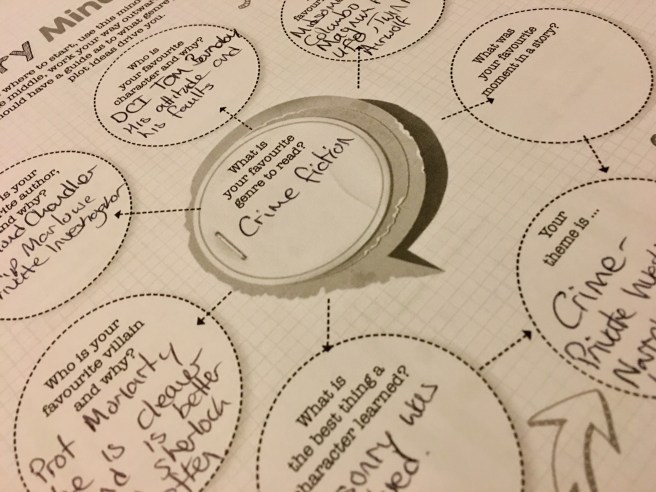
Producing a novel is not a quick and easy process. You have an idea for a story. Okay, which genre? Crime fiction with sub-genre Hard-Boiled Detective, and Female Sleuth.

You get told by Literary Agents that it needs to be different, so you read a lot of novels in the genre you want to write within. At the same time, you get told by tutors on writing courses that it needs to be the same as other published books. Quite confusing as you read the genre and they all seem very similar. Publishers have the mindset that, “If it works and sells, do it again.”

You look at outlines for novels and find they are three act structures, a beginning, a middle and an end. These three act structures are broken down into eight categories which can be found in many stories:

Trigger Event – (For a P.I. this would be the client interview)
Inciting Incident – (Not needed in a series of a P.I. as it’s her job)
First Pinch – (Pinch is things not going according to plan for the P.I.)
First Turning Point – (This look to be going excellently for the P.I.)
Second Triggering Event – (Second problem occurs)
Second Turning Point – (Things get even worse for the P.I.)
Second Pinch – (It’s looking like the end of the P.I.)
Climax & Resolution – (P.I. is down but not out & rebounds to victory)

Okay, the original idea for a story was not a full three act outline. I need a three act outline, so I need to invent a backstory, some sub-stories, as other things are happening to our protagonist and events that are in the above list. Within the story, things should happen that is likely to occur in reality and timeframe, so the year, month, day and time should be identified and adhered to, within the story.

Creating an outline & writing the first draft can take a year or years.

After you finish the first draft, you have to edit it.

After you’ve edited your manuscript, you need to send it to a few critique partners, who then read your manuscript and send you feedback, again this can take weeks to months.

Then you look at their feedback and edit again, once you’ve done that you could send it out to beta readers for their reviews, this can take months.

You take their feedback and edit your manuscript again. So now you have a semi-polished manuscript when there are two alternative courses:

1: Traditional Publishers; you send it to your agent who then edit it professionally, which takes months and send you feedback, so you change things and then it might be submitted to a publisher who then reviews it and sends you a long list of editing that is required on your manuscript. While all this was going on, you need an audience as publishers keep their money for publicising for well-known authors. So you get on social media finding people who like the genre you write and getting them to look at your website so people might buy the book, 70 to 80% of the cost goes to the publishers and you merely get 20 to 30% of the profits.

2: Self-publishing; you send it to a professional editor, and they have it for a month or two and send you feedback with edits. Then you need a book cover, you find a cover designer and send them the synopsis of your book, and they design the cover to compliment the subject. You decide you want ebooks and paperback books which both need different ISBNs, so you need to buy those. While all this was going on, you need an audience, so you get on social media finding people who like the genre you write and getting them to look at your website so people might buy the book. The ebooks you can format yourself and maybe Amazon will sell them for a fee. The paperbacks you want, so you have them manufactured at maybe 25 to 50 at a time, depending on the supply requirements and costs. Then you take all the profits.

Protagonist Faults

fullsizeoutput_2944

Your main character or the protagonist should not be perfect. It’s not realistic. Pretty much every character requires at least a common flaw unless they’re a flat character with no real personality. The ideal character would not be enjoyable to read.

Your character’s attributes will define their every action and reaction. Your character has too many useful features, and can’t possibly be all these contradicting things all at once. Someone who is brutally honest, good at arguing, and unapologetically opinionated isn’t very likely to also be peaceful and even-tempered. The first three attributes speak of an entirely different person than the last two. And, often times, character attributes that seem like good things can become flaws when brought to their extreme. Yes, honesty is a good thing, but it can get your character into trouble because people don’t always like to hear the truth, white lies are widespread.

You should re-examine and re-build a character from a different angle, and focus more on making a character like a real person than adding as many good attributes of which you can think. Even if your character seems perfect on the surface, it is highly unlikely that they are that perfect in reality. Someone this perfect will never actually do anything because their contradicting positive characteristics and lack of flaws don’t give them any motivation to act.

Looking at famous characters like:
Columbo, a routine type of guy that is scared to fly in a plane or helicopter and be in hospitals, forgetful and likes a good cigar. He is also the best Homicide Detective on the planet.
Superman, He does have a problem with Kryptonite and being in its location He is apparently an off world being that has greater strength and abilities than humans.
Jason Bourne, a brilliant and tactical man that knows his limits and can work around them very successfully. He was on drugs that gave him lots of headaches and difficulties driving at night with headlights in view.

Character Arcs

arc

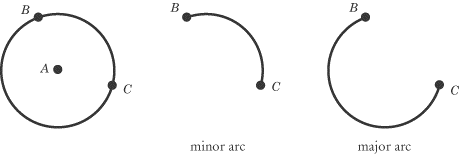
What is a Character Arc?

The definition of a character arc is thought to be something to do with how the main protagonist or hero/heroine changes within a story. In some respect this is correct, it is inaccurate to assume that this means every main character needs to undergo some major alteration. Recognising the difference between growth and change is crucial to the proper implementation of the character arc in a novel.

Main characters do indeed need to grow. A story cannot grow naturally if the primary characters within it do not develop and adjust to the shifting moving tides. When a story advances from one area of exploration to the next, the main character needs to update also. That method is how stories work. Therefore, it is easy to see how the growth, and the main character’s progress, is inherent in the mechanisms that progress a novel.

When you discuss change and how the main character “has” to change, you’re making an assumption about the characteristics of that growth. Not all growth is transformative. Sometimes a character can grow by supporting their status, shoring up their resolve against whatever is hurled at them. This is no less significant than the sort of growth where someone develops who they are or how they see the world.


The Reader is Actually Clever

It is better to only give the reader what they need. There is such a bad thing of information dumps in a scene. Trickle the information and do not put paragraphs of information as this is bad. 

The reader is often thought of as forgetful and in need of being reminded of things. So as a writer, you repeat things as it is thought that a reader will not sit and read for ten to twelve hours and finish the book in one reading. Even though, you must not repeat things as editors and publishers will not like this attitude.

Also the reader is clever and more clever than you think. When you make half suggestions within your writing, it is clear to the reader; you do not have to enforce the suggestion over and over again.

If your story is interesting enough, then information will not need repeating to remind the reader as they will be on the ball. The story must have a beat that keeps the reader reading the next page.

The 5 ‘W’s & the H

fullsizeoutput_28fb

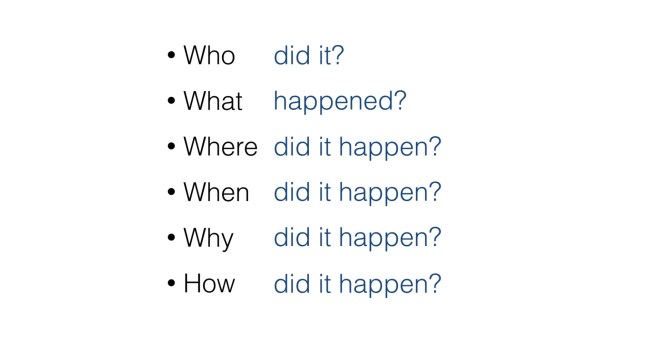
Each scene needs the 5 ‘W’s & the H.

When you write a scene, it must be a scene that furthers your plot. In fact, I’ve come to realise that every single word must have a reason to be there. Not just every word in a short story of 1000 or 2000 words, but every word of an 80,000-word novel must serve a purpose or get deleted.

I’ve had a word limit of 2000 words and written a story containing 1300 words. Word limits or expectations are truly horrid things. If like me, you were given a word count expectation, then words creep into the story that does not find a necessity to be there, just to fill up a word count. The sentences that I added to the 2000 word short story so I could increase the word count were found and held up against me as being weak content in the story.

Every scene, like each scene in a movie, should show who was doing things, where things were and when things were happening, what was going on, why the events were taking place and of course how things were done.

I appear to overwrite as I have submitted work on a course and been told that it is too wordy and a lot of it could be deleted. After a few months of doing this pass by, you start to wonder how there could have been 587,000 words in Leo Tolstoy’s War & Peace. A long story novel indeed, but not the longest; ‘Men of Good Will’ by Jules Romains contains 8000 pages with 2,070,000 words. So if every single word adds to the story, it must be a very, very, very long and fascinating story.

The Perfect Rhythm of English

You may have an author or a particular book you read a lot because you like it. Why? What is it about the book? The Characters, the story? If you don’t know, which may be the case, try to read it out loud. It may be the rhythm of the sentences. Here is the rhythm of beautiful English:

da DUM

da DUM

da DUM

da DUM

da DUM

This is the Iambic Pentameter 10 beets, unstressed syllable and stressed syllable. When we speak, our syllables are either stressed (stronger emphasis) or unstressed (weaker emphasis). For example, the word remark consists of two syllables. “Re” is the unstressed syllable, with a weaker emphasis, while “mark” is stressed, with a stronger emphasis.

In poetry, a group of two or three syllables is referred to as a foot. A specific type of foot is an iamb. A foot is an iamb if it consists of one unstressed syllable followed by a stressed syllable, so the word remark is an iamb.

Pent means five, so a line of iambic pentameter consists of five iambs – five sets of unstressed syllables followed by stressed syllables.

Why do you think William Shakespeare’s plays are still very popular today, 401 years after he lived (26th April 1564 – 23rd April 1616) Each line consists of an Iambic Pentameter:

  • But, soft! what light through yonder window breaks?
  • It is the east, and Juliet is the sun. (William Shakespeare, Romeo and Juliet)
  • Her vestal livery is but sick and green
  • And none but fools do wear it; cast it off. (Shakespeare, Romeo and Juliet)
  • And I do love thee: therefore, go with me;
  • I’ll give thee fairies to attend on thee,
  • And they shall fetch thee jewels from the deep,
  • And sing while thou on pressed flowers dost sleep; (Shakespeare, A Midsummer Night’s Dream)
  • Now is the winter of our discontent
  • Made glorious summer by this sun of York;
  • And all the clouds that lour’d upon our house
  • In the deep bosom of the ocean buried.  (Shakespeare, Richard III)
  • Henceforth be earls, the first that ever Scotland
  • In such an honour named. What’s more to do,
  • Which would be planted newly with the time,
  • As calling home our exiled friends abroad
  • That fled the snares of watchful tyranny;
  • Producing forth the cruel ministers
  • Of this dead butcher and his fiend-like queen,
  • Who, as ’tis thought, by self and violent hands
  • Took off her life; this, and what needful else
  • That calls upon us, by the grace of Grace,
  • We will perform in measure, time and place:
  • So, thanks to all at once and to each one,
  • Whom we invite to see us crown’d at Scone. (Shakespeare, Macbeth)
  • O that this too too solid flesh would melt,
  • Thaw, and resolve itself into a dew!
  • Or that the Everlasting had not fix’d
  • His canon ’gainst self-slaughter! O God! O God! (Shakespeare, Hamlet)
  • Arise, fair sun, and kill the envious moon,
  • Who is already sick and pale with grief,
  • That thou her maid art far more fair than she:
  • Be not her maid, since she is envious; (Shakespeare, Romeo and Juliet)

They all sound very beautiful and comply with the Iambic Pentameter. One that is a little awkward is:

  • To be or not to be, that is the question. (Shakespeare, Hamlet)

Clearly it is very famous, but it doesn’t sound just right, does it? Why? It’s because there are eleven syllables. Just one too many, and throws off the rhythm. In Macbeth, Shakespeare used the Iambic Pentameter the opposite way round to make it feel uncomfortable when the witches spoke. Stressed syllable, then unstressed syllable.

  • Double double toil and trouble fire burn and caldron bubble.

So, the correct rhythm in text is important and can lead to someone wanting to read more.

Hard-Boiled Detective Fiction

The Hard-boiled Detective Fiction

This sub-genre was born in Los Angeles, California, USA. In the early to late 1930s, when life was hard, and the threat of war and financial depression/austerity was hitting everyone, somewhat like today’s USA and UK.

People were moving there to write, and some lost out. Whereas, Dashiell Hammett and Raymond Chandler told stories that hit the heart of real life with bitter, angry and drunken detectives. Where their investigators used their intelligence and intellect, looking for clues in everyday life and observed normal human nature.

There was no side-kick as in many detective fictions, to talk matters over for the audience’s understanding. Such as Sherlock Holmes and Dr Watson. Inspector Morse and Sergeant Lewis. Hammett and Chandler used the first person so they could integrate Philip Marlowe, Mike Hammer and Sam Spade’s thoughts into the story.

There was usually a murder, but not much violence occurred after the discovery of a dead body.

What are Story Plot Holes or Plug Holes?

fullsizeoutput_28e3

Plot Holes or Plug Holes?

A plug hole is where the water goes. A Plot hole is slightly different. Plot holes in long stories are gaps or logical inconsistencies in the narrative that disrupt the logical order established by the novel’s plot. Events or statements that contradict earlier events or declarations in the story fall under this category.

For example, in sci-fi/fantasy involving time travel, a protagonist can’t go back in time to prevent an antagonist/villain from being born. The earlier removal of the villain would negate any need for time travel in the first place, this being a classic time travel paradox.

Famous instances of plot holes in fiction include a little-discovered error in the first U.K. edition of Harry Potter and the Philosopher’s Stone by J.K. Rowling. On page 56, a witch complains about the price of an item being “seventeen Sickles”, yet in the monetary system of Rowling’s world, there are seventeen Sickles to a Galleon. The witch would more likely say “one Galleon”. Although this is a very minor oversight, the inconsistency was changed for subsequent editions. Clearly, an editor needs to be used in everyone’s novels.

Short Story – Urban Fantasy

fullsizeoutput_28a7

Late For Work

  • You see an otherworldly creature on the way to work. No one else can see it. What do you do?

I was late for work and thought, “Oh, come on, as the group manager is here today.” The traffic seemed like it wanted to make me late as it was so slow. I left the bus at East 14th Street; near Union Square West. I hurried on my way to the coffee shop. It was already 7:05 a.m. and the sidewalk was busy with people going to their jobs. We all had to avoid collisions with each other. There were all types of characters, tall, short, well dressed or in work clothes.

A flash of blue caught my eye in an unusual location. I saw a small person dressed in a convincing costume. It looked like a blue coloured alien. A large head with brain-like shaped curves. There were lots of red blood vessels wrapping around the characters face and upper body. A fabulous costume, and looked brilliant. I smiled at the costumed person and walked passed.

The coffee shop was only at the end of the block. A car screeched around a corner behind me, so I twisted my head to look. The alien looking character was right behind me. I stopped and turned around to talk with this person. “Why are you following me? Can I help you? Excellent costume by the way.” There was no reply. I frowned and turned to continue my walk to work.

Several steps later, and trepidation got the best of me, so I twisted my head and looked. The costumed person was still walking behind me. I stopped, turned and said, “Look, what do you want?”

No response. I crouched in front of this character. “Are you not going to say anything?” Reaching to touch its arm, I could feel the warm blue surface. I removed my hand with some shock as a costume would not have warmth. It had large red eyes, and its body was blue in colour with muscled arms and legs. No nose, or lips around its small mouth. I’d been in front of this being for about thirty seconds. I saw passers-by looking at me with an expression of confusion. A man walked by, and his face seemed dismayed. A young woman glared at me, so I spoke to her, “This is an alien and not a dress costume.”

She giggled and walked on her way. What was so funny? Couldn’t she see the red-eyed blue character in front of me? I caught the eye of another passer-by. This one was a man in a suit scowling at me. I spoke louder, “Hello there, what’s the problem? Can’t you see this strange costumed person here?” He gave a sigh and had a look of disgust on his face. He turned and walked on.

Now I was becoming uncomfortable with fear and confusion. I crouched lower in front of this blue, red-eyed alien. “You appear to have chosen me on purpose. Why me? —I only work at a coffee shop along the road. There are others who would help you much better than myself.” I looked at this alien in one of its huge red eyes, and its head moved to one side like it was trying to learn. I sat cross-legged on the floor in front of the blue alien. I took my mobile phone out of my pocket and said, “I’m going to phone someone who can help, ok?” looking at it in the eye. It didn’t seem to understand anything. I called the police and said, “Hello, I’m sat in front of a red-eyed, blue alien on the corner of East 14th Street. It’s near Union Square West.”

The officer on the phone responded, “Indeed? Oh, this is a prank call, isn’t it? I’m busy, please don’t prank call.”

“I realise this sounds absurd but…” the phone was then hung up. Damn. I turned my phone off.

All right, I was in a situation, and I needed to take action as this grey alien is real to me. I looked back into the eyes of the blue creature and thought, “If I could see it, someone else might too. All I need to do is to make matters clear to the people in the area. Someone might also see the alien. There was a fire hydrant, behind the alien. I made sure the creature was close to it. I stood to my feet and moved towards the steps leading into a building. I’d be in a greater location to speak to everyone. On the third level, I could see all along the block, and there were fifty people in view. I announced, “Excuse me, everybody!” This got a lot of attention. “I have this situation, where there is, in fact, a strange creature near this fire hydrant.” As I said this, I was pointing to the blue large-headed alien. “I have come to the assumption not everyone can see it.” At this moment, everyone was beginning to look away and walk in their original direction. “Someone must be able to see it.” A group of five men stopped in front of me, and one asked, “Where is it?”

So, I responded by saying, “It’s right in front of that fire hydrant—there.” As I pointed to the red-eyed, blue alien. It raised its massive blood veined head and seemed to smile at me. Then it disappeared altogether. “Oh, it’s now disappeared to me too. Oh shit! Not my day is it.” Everyone was still looking at me. The embarrassment was overwhelming, and I wanted to disappear myself, but I couldn’t. “Err…”