My Short Story Reviews

Two reviews of My Short Story are listed below:

  1. First Review:

    I LOVE the Big Bang Theory, and this could’ve been a very clever and funny story that referred back to that series. However, there were far too many grammatical and wording issues, that got in the way of enjoying the story. It is muddled and confusing tale, and the ending is the only funny and easy to understand aspect of your story.

    There were several sentences that didn’t make sense.

    For example: “ Work is one of those locations where you do something for someone else, and they pay you money.” Most people know what work is, this was a completely unnecessary sentence.

    In that same paragraph you say this: “ I turned the stereo on to my CD, and the music of Elvis Presley became evident.” The wording here is awkward.

    Neither sentence was germane to the story, and in a story that’s 2,000 words or less, you need to be judicious with the words you use, and these kinds of random sentences feel as if they have a point, but that is never made clear, and this can cause the reader to lose interest.

    Also, it was never explained why the aliens chose this character, he had no connection to the government, and no real power to help the alien.

    The whole story felt lost, as if it was trying to find its way but never did. However, the premise here is wonderful, and with some work this can be a funny and engaging story. Do not be discouraged, keep writing, and working on what appears to be a wonderful imagination. Take care.

  2. Second Review:

    This might not sound like much, but I want to give you full credit for having a comprehensible story. It was easy to follow from beginning to end and never got choppy with the timing of events or description. That’s a core skill many aspiring writers are missing.

    One issue us that the majority of the story is a set up for a Big Bang Theory joke at the end. That’s mostly fine, but there wasn’t much information letting the reader know that’s where you were heading. Other than the aliens being dismissive of English, there weren’t a lot of clues throughout the story that hinted at this being a comedy. It’s vital to set the tone early, so that the reader isn’t thrown so hard they break immersion with the tale. It’s been said before that the best ending to a story is both inevitable and surprising. Of those two, inevitable is the harder aspect to manage.

    That said, you have lot of potential. You can tell an oddball, even silly, story without it being confusing. I hope you keep improving. I hope you keep writing.
Contractions


Within the text of a novel, it’s best to use contractions. Here are a few:

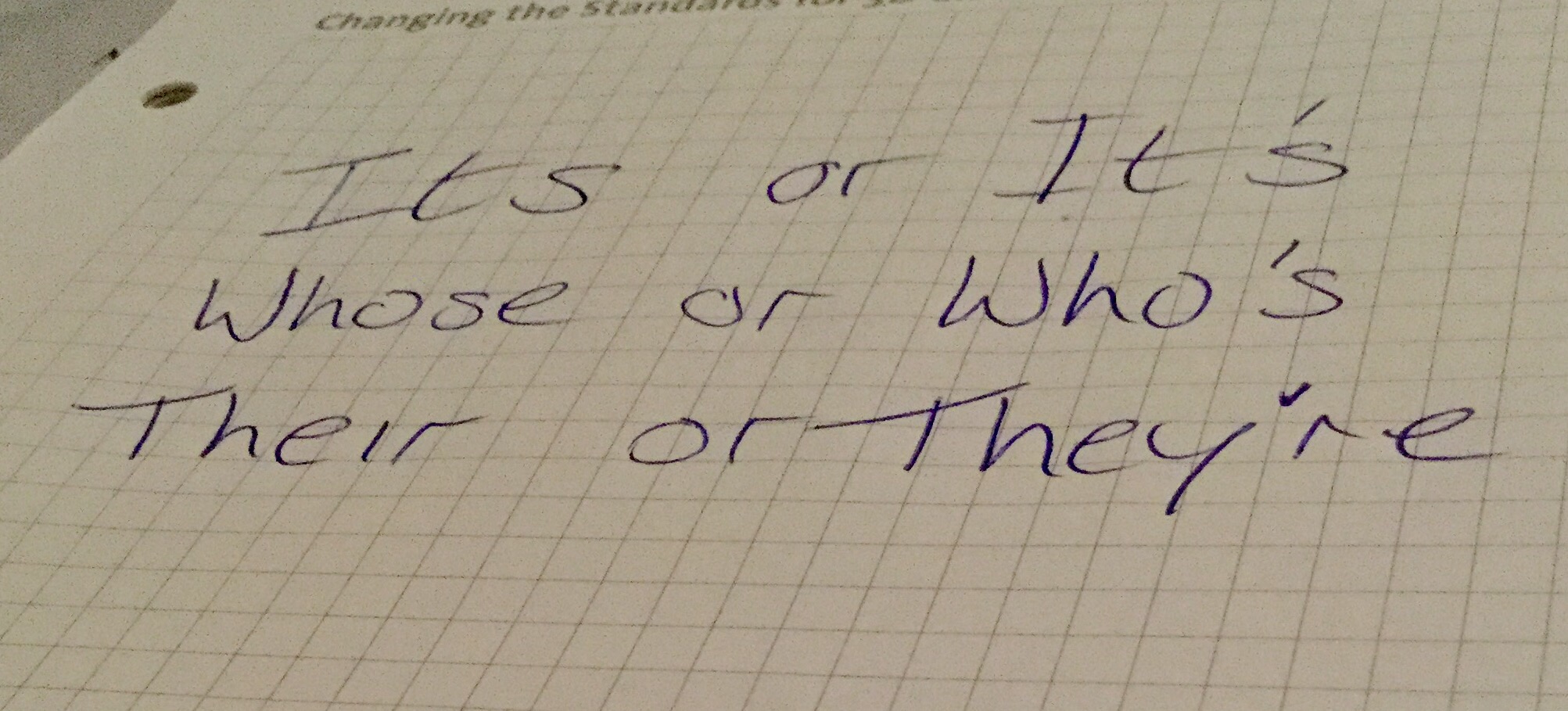
Its or It’s
The contraction of it is = it’s
The possessive term of it = its
Examples:
It’s my Birthday.
My dog wags its tail.
I leave my house by its front door.

There is no such term its’

Who’s or Whose
The contraction of Who is = Who’s
The possessive word of who = whose
Examples:
Who’s paying the bill?
Whose house is this?

They’re or Their
The contraction of they are = they’re
The possessive term of they = their
Examples:
Bill said they’re his clothes.
The problem is their fault.

Using Numbers in Text

When writing a novel, there will be numbers used like dates, times, years, ages, money, and just quantities of anything.

Do not start a sentence with a numeral, as it is distracting:

59 tickets were sold last Tuesday.

The common practice is:

Fifty-nine tickets were sold last Tuesday.

Some writers spell out all numbers from one to one hundred and use numerals for anything higher as nine thousand four hundred and sixty-two is a little more wordy than 9462.

“Brian gets £45 an hour,” is somewhat better to read than, “Brian gets fourty-five pounds an hour.”

Conventions on numbers from publisher to publisher varies.
Just stay consistent.


Plot or Story

What’s the difference?

There is actually a difference between a plot and a story. It’s like a novel and a movie.

So, movies show a lot of scenes with action things happening that are usually dramatic. Most movies show activities from the perspective of many people. Things happen to the characters, the protagonist and antagonist, along with other extras embark on a journey of excitement. Each character shows emotions and attitude towards or against the things happening.

A Movie, most movies show activities and show their feelings towards some action. Some movies follow a narration from the protagonist or antagonist. This character is always in every scene, and thus narration.

A Plot

A plot is the action and what happens within a scene in a movie or novel. Movies are flooded with the plot.

A Story

A story is the emotions that the characters experience. The emotions of characters in a novel are quickly shown and described. It is a lesser part of a movie as the emotions are only presented with actions.

PREMISE/LOGLINE

Placeholder Image

Premise/Logline

A protagonist (2 words) who wants something (goal) and is willing to go through conflict (antagonist) to get it (result). Premise here:

Maria Logan, a private investigator in Berkshire U.K., takes on a case for a wealthy old lady to find her stolen gold coins by an associate family member, so she doesn’t want police arrests. Maria comes across murder, blackmail and her past still torments her via a phobia.


Writing a Gripping Story

1. Start with a sense of stress

You will hear fiction authors or instructors tell you to start with action. The answer to that is No. Why? What asset is the performance if it isn’t grounded in a context that’s relevant to the novel or draws you to the main character? It’s better to start with tension, like a character falling short on getting something he wants—can’t save the life of a loved one. In a private detective story, I have been told by a literary agent to start in the interview with the potential client.

2. Know your characters

Fascinating stories come from characters who want something. Romeo and Juliet want each other. James Bond intends to complete the mission, and get the girl. Columbo seeks to solve the problem.
Writing fiction work requires you to have compelling characters, and characters who have strong wants, desires that are the most compelling kind there are. The trick is not to make them perfect. No one can identify with an excellent character, as no one is perfect themselves. Columbo had strange fears for being a police detective. He didn’t like dead bodies or hospitals. He didn’t like flying. These concerns are shared, and a lot of people can relate to those characteristics.

3. End each chapter on a cliff

OK, you don’t have to finish each chapter on a cliff, but you do need to leave them with open issues. That doesn’t mean you can’t answer questions during the novel. Fiction is built on the imagination and curiosity of readers. If you don’t spark their interest (especially at the end of a chapter), what incentive do they have to start the next one? This is why I’m just writing the novel, and when complete, that is when I will cut the chapters. This means I can manipulate the story in some locations to create suspense.

4. Give your characters obstacles

The obstacles can be as challenging as you want and the idea is when you think they have been through a lot, make it worse. Like the scene in Pitch Black where they lost their electric source for the lights, so they used flames and then it started raining hard. But the key here is that they have to be able to overcome the obstacle no matter what it is, etc. Fictional writing is strongest when characters face terrible odds and still come through in the end.

5. Understand your genre and audience

If you are writing a crime novel? Erotica? Or Sci-Fi. Fiction genres are different and are told in a variety of ways, so audiences of each have different expectations that you need to cover. If you’re writing crime fiction, you have to reveal what happened early. Spend the novel solving the offence, but the clues must appear in the story and enable the protagonist to solve the crime or crimes when the reader has not noticed the clues. The crime should be solved independently from the text already written. The idea is to place the clues in the story when they don’t look important and give evidence that doesn’t mean anything when it appears significant. If you’re writing a thriller, your story is dedicated to characters trying to stop whatever it is from happening.

A Beat Sheet

What is a Beat Sheet?

A beat sheet is a blueprint for your story, and listed below is a generic beat sheet. The way people attack this is to change things within the beat sheet. Make things different. How different it can be is limited to what you can get away with, and still sell books.

ACT I

OPENING SCENE: The hook.

Start in the middle of an action, a scene which reveals an unusual trait of your main character that will make your reader want to know more about him or wonder what will happen next. Get your readers hooked!

Exposition: Introduce your hero and the world in which he lives.

Show the biggest need of your hero, his problem, his greatest flaw, his missing piece. It will give your readers a clue about the inner journey of your character and prepare them for the Midpoint Climax.

TURNING POINT: Event that irrevocably disturbs the hero’s world as he knows it and introduces the antagonistic forces.

Your hero can’t go on with his life-like before, his world has been turned upside down, the balance is thrown off, and he will have to make a choice and take action.

He may refuse the Call at first, deny the fact that he must do something, try to keep things as they’ve always been and eventually realise that he can’t go on like this, that his world has irrevocably been changed.

ACT II

BEGINNING OF ACT II: Your hero declares his goal. His journey begins.

It is most interesting when his goal is at odds with what we know he needs. It will make the Midpoint Climax all the more satisfying when your hero realises what it’s all about.

The introduction of your sub-plot.

This is a good time to start your sub-plot that will develop throughout Act II until your hero experiments a major setback where everything seems lost and then realises, thanks to the sub-plot, what has been missing that will help him defeat the antagonistic forces.

PROMISE OF THE PREMISE: Your hero explores the new world.

This is the fun part where your readers get what the premise promised, be it a detective finding clues, love blossoming or an adventurer on his quest. The stakes are small, and your hero has the upper end, the story progresses quickly.

The event that increases the stakes.

The commitment of your hero to his goal is getting more dangerous.

MIDPOINT CLIMAX: Context shift that changes your hero’s understanding of his goal / the stakes / the antagonistic forces.

Your hero realises that he has been pursuing the wrong goal or that the stakes are much higher than he anticipated or that he has severely underestimated the antagonistic forces.

It can also be a moment when he realises that the goal he first set doesn’t match with his real need and he’s willing to change the direction of his path to fulfil the need we saw a glimpse of at the beginning of the story.

The closing in of the antagonistic forces.

The stakes get even higher, the task more challenging and we begin to understand what are the antagonistic effects.

MAJOR SETBACK: All seems lost.

Your hero hits bottom, and everything seems impossible.

ACT III

BEGINNING OF ACT III: Your hero reaffirms his goal after discovering something from the subplot that may help him overcome the antagonistic forces and was missing before.

This is his last chance at defeating the antagonistic forces. He will win or fail, but there’s no turning back. The stakes are at their highest.

CLIMAX: Hero’s big fight against the antagonistic forces.

Final battle where your hero’s destiny will be decided. Whether he achieves his goal or not, his world and life will be forever changed.

ENDING SCENE: Glimpse into the future.

This scene is showing how the hero has changed and what is his new world.

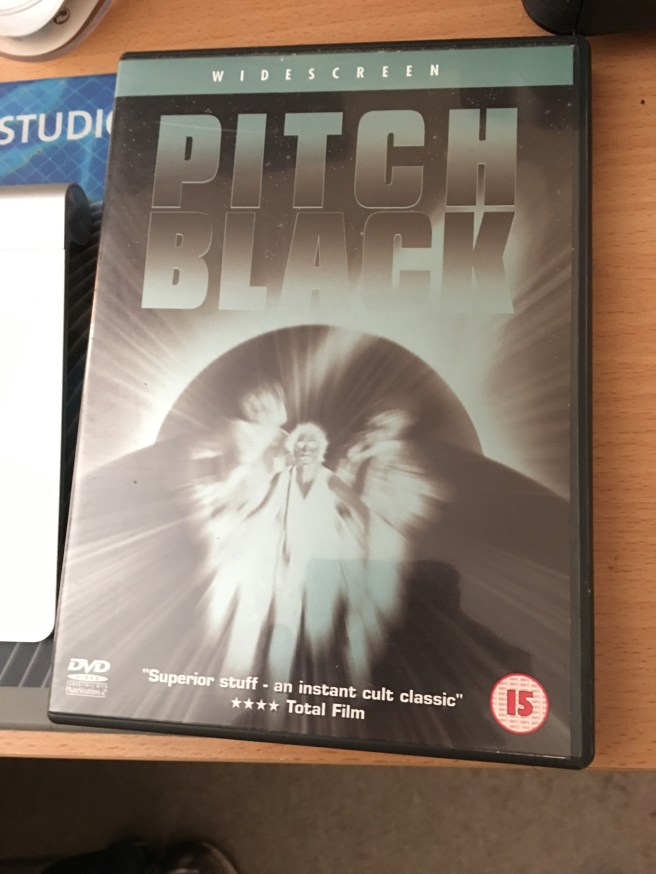
Pitch Black (2000)

WARNING: Film Plot Spoiler – Pitch Black (2000)

IMG_0506

This post is a review of an excellent film that I wish was a book.

Narrative Opening – Richard B. Riddick.

They say most of your brain shuts down in cryo-sleep, all but the primitive side, the animal side—no wonder I’m still awake.

Transporting me with civilians sounded like forty, forty-plus, heard an Arab voice, some who-do holy man, probably on his way to new Mecca, what route, what route. Smelt a woman, sweat, tool belt—leather, prospector type. Free settlers and they only take the back roads.

And here’s my real problem—Mr Johns. Blue eyed devil, planning on taking me back to slam. Only this time he picked a ghost train. A long time between stops, and a long time for something to go wrong.

This film uses the ‘W’ plot line, where you begin with the regular action, but then comes trouble. Later on in the movie, the characters appear to work their way back to normal. Then all hell breaks loose, and the main characters are in a life threatening situations. After a few deaths, the protagonist of the story wins through and is back in typical life situations.

This movie uses dialogue to hint at trouble, then trouble arises. This version is not as bad as ‘The Martian‘ where a character says “That’s assuming nothing goes wrong.” and then within a minute crisis occurs. That version was terrible. Having read the book, The Martian, the novel and then seen the movie. They are quite different. In a movie, you can only show activities that can be obtained on Earth. Whereas in a book you use imagination, and that can do anything and go anywhere. – Back to Pitch Black…

Pitch Black W Plot – Time stamps taken from my DVD of the film

0:00 – Hook: Opening narrative and spacecraft hit by meteor storm particles that resolve in a lack of control and crash on a planet.

16:00 – Exposition: Introduction of Riddick, the narrator and assumptive protagonist. Where he is, what he wants and the current situation. He escapes showing flexibility in his limbs. Also, three suns and no night-time on the planet proved to exist.

25:00 – Turning Point One: Protagonist is disturbed and the introduction of antagonistic forces.

27:00 – Protagonist captured again.

28:00 – Protagonist reveals that his eyes can see in the dark and is not happy with daylight. Not suitable for a planet that has no night-time.

32:00 – Sub Plot Introduction: Alien animals eat meat but don’t like the light.

35:00 – Promise of the Premise: Riddick let out of restraints as he didn’t kill the surviving passenger, but the aliens did.

44:00 – Increasing the Stakes: Impending Eclipse and have to move quickly before the aliens of the dark come and kill everyone.

47:00 – Midpoint: The Character Johns found out to be a mercenary and not a policeman. Also, Johns had a morphine addiction and didn’t give morphine to help Carolyn Fry’s dying crewman. So Johns the Antagonist?

50:00 – Eclipse starting, and alien Antagonists enclosing.

53:00 – Turning Point Two: Eclipse happens when the characters are a distance from the found shuttle craft and escape—Characters need to go out in the dark, with the aliens.

66:00 – Beginning Act III: Reaffirmation of goal and subplot subjects become apparently involved.

74:00 – Climax: Riddick has a battle with Johns the antagonistic mercenary.

83:00 – Electric lights go out and only left with flames of fires—As with all good stories when you think things can’t get worse, make them, even more, worse—it starts to rain putting out the fire flames. Aliens move in and take a few characters to eat. Characters find shelter.

85:00 – Riddick off to ship but Carolyn Fry goes after him. Riddick tries to turn her to leave the others.

91:00 – Carolyn Fry pushes back and convinces Riddick to go back for others.

94:00 – Riddick, the protagonist in trouble and Carolyn Fry, asked to leave him by other survivors. She wants everyone to survive.

95:00 – Carolyn Fry dies trying to help Riddick—he didn’t like that at all as he never wanted his life to be someone else.

97:00 – Riddick kills some alien animals as payback for killing Carolyn Fry and the mark of the protagonist.

98:00 – Back to the normal lifestyle.

This movie would have been a terrific novel but there isn’t one – Very sad!

Someone Who Lies Does…

All these aspect of lying should be noted and inserted to the actions of a character that is lying at the time. Afterall, writers should show not tell.

1. Lack of or too much eye contact

The biggest indicator someone is telling a lie is lack of or too much eye contact. It’s a common belief that when people lie they avoid eye contact and look elsewhere. While this is often true, some liars make too much eye contact just to make you believe they are speaking the truth.

2. Foot movement

When people lie they often exhibit signs of nervousness or anxiety. Foot movement is the biggest indicator of anxiety and nervousness. Liars often shake their legs or make regular leg movements to avoid tension and run away. This can be used as a clear-cut clue to catch a liar.

3. Shorter responses

This is a verbal clue displayed when people lie. When lying people often stay silent during the conversation or offer shorter responses. They also use more ums, ers, and ahs to fill in the gaps. If a person is making more speech errors it’s an indication of lack of truth.

4. Change in pitch

If you observe someone communicating in higher pitch than normal it can be a sign of lying. Some people also maintain lower than normal pitch. High or low pitch indicates there is something off.

5. Shoulder shrugs

People often shrug their shoulders when they don’t know or agree to something. If someone is shrugging while speaking it may indicate they don’t agree with what is coming out of their own mouth.

6. Too much sweating

Some sweat excessively when they lie. This abnormal sweating happens because of the adrenalin rush from anxiety and nervousness.

7. Changing the Subject

The thought process required to support a lie should be fast. Not everyone has fast thought processes so they change the subject to something completely different.

8. Fidgeting

When people lie they often touch objects lying around to relieve stress. Some people might act as if they are more interested in the object than the conversation to avoid confrontation.

9. Face touching

Studies have found that when people lie, they often rub their nose. It’s a scientific observation, experts believe the adrenaline rush opens the capillaries of the nose making it itchy. Some people also cover their mouth and eyes while lying, this is an uncommon observation.

10. Excessive lip licking

Lying puts stress on our body and the biggest indicator of body stress is a dry mouth. In order to rectify the dry mouth, liars are often observed licking their lips often.
Unless the liar very staunchly believes in his/her lie, the above mentioned points should easily help you in spotting a liar.

Novel Structure

There is a formula for a crime fiction  novel or movie, although every story is different and how can you have a formula for things that are different? Here is a formula that takes the general mood in sections of a novel or film. It’s always easier to begin at the end of the novel or movie and work backwards to the beginning, as you know where you have been.

The Hook – (Write or outline this 2nd) If you managed to note your ending without breaking out in plottery hives, then the hook is easy. The start of a book is generally the opposite to the ending. Take Stephen King’s Shawshank Redemption – At the start he’s trapped in prison, at the end he’s free.

The Plot Turn One – (Write or outline this 4th) Your books moving along nicely, everyone’s happy and then Oh No, there’s conflict/problem/world ending disaster fucks shit up for your hero. This sets your characters on the hook to the midpoint.

The Pinch One – (Write or outline this 6th) Conflict got shoved in earlier and now you get to rub your evil writing hands together and make shit a lot harder for your hero. Apply pressure, use the villain. Throughout the hole story, when you think the hero has had enough shit happen to them, give them some more. The movie Pitch Black shows this well. Things are crap, but then things get even worse.

The Midpoint – (Write or outline this 3rd) The mid-point is pivotal not just because you’re half way through your blood sweat and tears journey but because your characters move from reaction, to action. Of course it doesn’t need to be the actual middle, it could be 30 or 70% of the way through but wherever it is, it’s a change in the characters that moves from the villain driving the plot to the protagonist driving it.

The Pinch two – (Write or outline this last) This is the fun bit, you do your absolute worst and beat your hero with the villain stick while cackling and drinking a G&T. Screw shit up so bad for your hero that everything seems utterly hopeless. The villain’s clearly going to win because they defeated the hero in battle already and left the hero.

The Plot Turn Two  – (Write or outline this 5th) This is where your hero has an epiphany, solves the final clue or sets sail for an epic battle. It’s the point in your novel that moves you from midpoint to ending.

The Crisis & Resolution – (Write or outline this 1st) Every word you bleed onto the page leads to the ending. With the exception of hooking people in at the start, it’s the most critical part of any book. Even as a pantser you will have a general idea of how you want your story to end. Note it down first.