I have located a writing competition and intend to enter.
I’m pantsing it. What the hell, it’s a short story. Only 2000 words, four A4 sides.
Crime Fiction: Hardboiled Detective
Dr Philip Shepherd


I have located a writing competition and intend to enter.
I’m pantsing it. What the hell, it’s a short story. Only 2000 words, four A4 sides.
As you know from this web blog site, I’m plotting the story of a crime fiction novel series. Herein lies the difficulties I have so far encountered. A private investigator in the UK has no more rights within the law as you or I, going about our own business.
My protagonist is a self-employed private investigator, and she works within the law. Although, she may in certain circumstances, bend the law to the benefit of the client; i.e. sub-sub-genre; crime fiction noir.
Crimes have happened, and murders occur in public places. My story is set in a shop within the Oracle Shopping Centre in Reading. Having visited the shopping centre and parked in the multi-level car park in which you receive a ticket containing your own vehicle number plate marked and the date/time you entered. There are cameras on buses and trains. A few years ago I was on Jury Service in Reading, and one of the offenders was seen walking down the main high street with the stolen item, on a video camera.
Things must be realistic and plausible in this story. Performing a crime these days you need to plan everything to a great detail. If a shop entrance within the Oracle Shopping Centre is videoed continuously, then how does someone commit a crime within the shop and escape undetected? They would have to know what cameras there were and what scenes they were capturing, when and how long if the cameras were panning around. Also, a change of clothing, and hair colour.
Things that give messages about people, and can be used in evidence:
1, Hands & fingernails condition, hand cuts or blisters.
2, How well shaven, beard long/short, small cuts or red areas indicate wet shave, else electric.
3, Stains on hands if they smoke, left or right handedness would be evident.
4, Left or right handed, crossed arms – the dominant arm underneath.
5, What type of footwear, shiny, dirt or mud, worn soles, shoelaces or slip-on.
6, Limps or limb damage, the speed of the walk.
7, Glasses, longsighted or shortsighted, varifocals possible.
8, Mobile phone, silent ring, vibrating or big ring, how loud, type – iPhone or simple.
9, Makeup on a woman, what colour lipstick.
10, Smells, perfume, burning smoke, cooking food.
11, Trousers creased behind knees if sat down a lot during the week in a suit.
12, Vehicle type, sports, estate, saloon, works car – else walks, public transport.
13, Car keys, house key, any other keys on ring or assistance items such as a knife, etc.
14, Tablets, liquid medicine kind and dosage.
15, Ring on left-hand ring finger if married, type would indicate engaged or fully married.
16, Surplus items on clothing such as hair or stains, torn clothes or missing buttons.
17, Location of excess hair or stains would indicate the reason, possible pets.
The private investigator in my fiction can’t take fingerprints, but shoe prints are available to be photographed. Also, if first on the scene of an accident or murder that has occurred, the P.I. can inspect and take photos but not alter anything. Being aware that under forensic science your own presence and movements will be evident to the police after forensic inspection.
N.B. I have not visited the Oracle Shopping Centre, or any other shops in that vicinity, with the intent of observing their surveillance cameras. This aspect I am creating my own scenario that fits into my story.

Fig. 1. The ticket I received from the car park at the Oracle shopping centre.

First of all, I’m using a software package called Scrivener as it is very, very useful for writing long documents. It enables you to structure the content and research for each subject. I have separate files for each character and every location in which scenes are set. I also have a few pages of filled in questions about each character.
There are many fictional story plot structures available, but I am using a mixture of two or three of them for a private investigator scenario, as there are none available that I could find. Mine is as follows:
Act I: Set up:
– 1, The hook
– 2, Customer Meeting
– 3, The inciting incident
– 4, Plot turn 1
Act II: Conflict:
– 5, Pinch 1
– 6, Midpoint
– 7, Pinch 2
– 8, Plot turn 2
Act III: Resolution:
– 9, Stand back up
– 10, Climax
– 11, Aftermath, or review of events
This structure is fairly common and used in most films and novels.
Hook: A hook is the first few sentences in a story that will catch someone’s attention and keep them reading. Or, action at the beginning of a film that is exciting. Somewhat like James Bond and StarWars movies.
Customer Meeting: This is the meeting that the private investigator has with the client explaining their problem. Clearly relevant to my stories.
Inciting Incident: An inciting incident is an event that literally makes the hero or protagonist of the story interact with the problem that has just arisen.
Plot Turn 1 & 2: The plot turns are just the times that new information comes to light and things change. Such that the suspects change and different things make an impact.
Pinch 1 & 2: The pinches are bad news for the protagonist and things go wrong and the antagonist, which is the bad guys, gets the better is some way.
Midpoint: The midpoint is just the protagonist’s changed life and getting used to it, including new normal things happening.
Stand Back Up: This is where the hero of the story has been pushed down so low that you think the game is over. The attitude of the hero is inevitably strong-willed and relentless. The protagonist is apparently getting ready for a massive conflict.
Climax: The battle where the hero and the antagonist are in a fight for right and wrong. A lot of the time there is a murder attempt and an inventing escape by the good guys.
Aftermath and Review of Events: This is after the battle where the opponent has been found and beaten by the protagonist. While the police turn up the protagonist questions the antagonist to explain events and reasons for them. Also, an opportunity for the hero to fill in where they knew things were headed. Indeed, the Police finally turn up, and further explanation is imparted to the DCI, detective chief inspector of CID, criminal investigation department.

I’ve been having trouble with my grammar. The biggest problem was comma splices. I looked around and found Grammarly, which is an online service that corrects grammar problems, including comma splices.
With the confidence of the Grammarly program helping me with the problems, I submitted my work to my tutor. My instructor in America still found comma splices. Writing the following sentences, I expected to find an error:
The program found no problem. I sent the sentences above in an email, and they said it was going to take a while as English is complicated, the only language that does not like comma splices. So now, the online program finds the problems except sentence eight as they are still working on it. Grammarly replaces the comma with a semicolon. The semicolon is fine for standard English text except when it is dialogue, as I got the reply that nobody speaks with semicolons. The other solution is adding a conjunction like: for, if, when. When the conjunction joins terms that are of equal importance in the sentence then it is right to use a coordinating conjunction like: or, but, and. When the conjunction is joining a subordinate sentence, then use subordinating conjunctions like: until, because. Another problem is that not many people speak correct English, but it is still required for the characters.
A sentence is an object and a verb, so that’s it. Also, just then I ended a sentence with a preposition, which is not allowed either. There is also the passive voice, which is not allowed. I’ll discuss the passive voice soon.
PhD Engineering Student Ramblings
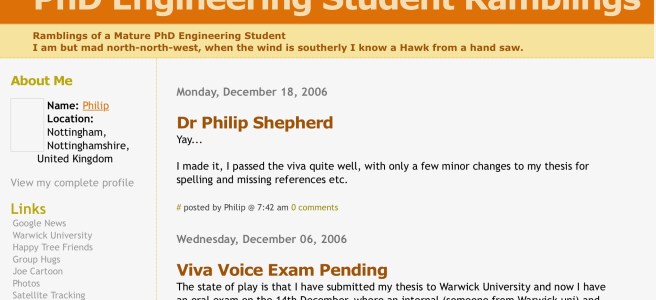
Above is a link to my student ramblings at Warwick University. I started in 2004, as I was at the university campus for the first year. When I was kicked out of there, I joined a student house in Leamington Spa. The house was a three-floor terraced house, and I shared it with twenty other PhD students. I had half a room, the wall went through the middle of a window. After the three years were completed my funding stopped so I had to get a job. I found a Post-doc job at Nottingham University. While doing that I continued to write up my PhD.

If you read a lot of the same genre from different authors, then you quite often recognise the presentation of certain scenarios. They seem similar. Why is this?
I have in fact come across—poor writers copy, and great writers steal. I have indeed stolen quite a lot. However, I may have copied a little, also.

Being a writer, the main part of your job is writing and the rest of it is reading what gets published in the genre that you have chosen. I have been looking on many websites for help with crime fiction story structure. There are a lot of plot help, and all are in the Three Act structure, which is fine. Many, in fact all of them are generic templates that follow the usual format. Attached is my Excel spreadsheet where you can outline the story with all the details. I created my own as there were not any avalable for narration single point of view.

I have found a worrying website. The Library of Babel. Within this library which is divided into pages, books, shelves, walls, and rooms, is all the text, created by Jonathan Basile.
This library has been built to locate and show on demand any page of three thousand two hundred character long combination of all the lower case letters of the alphabet, a comma, a space and full stop. This totals twenty-nine different characters, in a book containing one million three hundred and twelve thousand pages, incidentally, each book containing almost seven hundred million words. In essence, this library contains all the words that have or will be ever written, said, joked, lied, recorded, videoed. It contains the text for every single email, text, letter, song lyrics, poem, news article, journal paper, joke, lie and the transcript of every conversation anyone ever had or will have in english, or language that utilises the english alphabet. Each page is given a unique sequential page number, base ten. The characters on each page is locked inside a page number , base twenty-nine so it can be delineated to the lower case alphabet and comma, space, full stop. The algorithm will produce every different combination of the twenty-nine characters consistently, which means what is on each page is preset. So, every novel is in there somewhere, it just has to be located within ten to the five thousand pages. Considering that there are only estimated ten to the eighty atoms in the visible universe.
The above 2 paragraphs can be found in book volume 31 on shelf 4, wall 2 page 200 of 410. So, are the two paragraphs above original? unique? already published? already copyrighted?
Incidentally, 3,200 characters average out to 533 words if an average word is 5 letters plus a space, or comma, or full stop. I have noticed that 500 words fit nicely to one side of an A4 sheet of paper.

Sub-Genre Crime Fiction Noir/Hardboiled Detective, sub-sub-sub-genre Women Sleuths
I might go self-publishing or a mix in between, so I need my promotion and advertising. Blogging is the way to start and gain an interest.
I have in the past, before the accident that was inflicted on myself and changed my life started a book on an ex-CIA guy in Russia around the 1980s. I’ve always been a “Pantser,” that’s someone who writes and creates a story as it comes to mind when writing or writing by the seat of your pants. But got 20,000 words into the story and lost my way, so now I’ve gone to outlines and plotting the whole thing.
I was in a competition, NaNoWriMo, last November. It starts on the 1st and finishes on the 30th by which time you should have started and finished your novel containing at least 50,000 words, that’s 2,667 words a day, every day of November. Didn’t get too far as it is National Novel Writing Month.
So, late 2015 I had noticed that some people in China were producing great counterfeit gold coins and bars with tungsten as it weighs almost the same as gold. You had to scratch the gold to see if there was tungsten underneath, so people were getting robbed outright. Then early 2016 Fisch, a company that produced dimension and weight scales for gold coins, found that if the currency were held and struck, a gold coin would ring, but a tungsten coin would thud. Meanwhile, I was all over the place looking up South-African coins, their cost and sale values. Then ultrasound tools solved everyone’s problems by seeing the multiple layers within a coin or bar.
I thought about creating a Detective Chief Inspector, but researching current publications and founding there were loads so then I went to a private investigator like Magnum P.I. of which I have all seven series on DVD, bloody good Ferrari 308 GTS too. Also, I really like Columbo, which I have all twelve series on DVD. Then there is Jack Ryan, Tom Clancy’s CIA guy. Good films from the ‘Hunt for Red October’ and the ‘Shadow Recruit,’ but as normal the books are better. My hero Raymond Chandler wrote about a private investigator called Philip Marlowe, bloody good and in crime fiction noir based in the 1930s and 40s. I considered that genre and thought up a private eye. I was on a course for novel-writing, and they said it has to be different, looked at popular novels, and most of them were out there with detectives solving the crime before the person hires them. Most of them were male, so I thought female – entering a sub-sub-genre female sleuth. I looked around, and there were plenty of young women sleeping around and solving mysteries. A few old ladies like Miss Marple so I thought, “Ok, she’s a lesbian. What type?” Looked around and found a geeky/intellectual butch lesbian. The woman I found was DeAnne Smith a very good Canadian/American comedian. “Excellent, just like me but female.” Finished that course: pass. Did a course on crime fiction writing, finished that: pass. Did a course on forensic science, dead bodies are fascinating. Riga-mortice is cool, the second you die, your body loses temperature at about a degree an hour. Twelve hours in your limbs and features start getting stiff. This continues until between sixty-eight and seventy-two hours when muscles relax again. This is one of the things writers use to trick a reader.
Publishers rules contain:
1. Crime fiction genre stories, reading them, all the evidence must be in the story to solve the crime. That’s the problem as the solution must be a surprise, even though all the evidence is there to solve the crime. Result – a writer is someone who can tell a story and manipulate information to make it appear not or very important when it’s the opposite.
2. P.O.V. Or point of view there’s first person-single point of view, the third person-multiple point of view, and a third person-single point of view. They all have rules within them. I chose a first person-single point of view. This meant it is a narration, the protagonist the only person in the story telling it from their opinion. So, they must be in every scene over the novel. I’m not allowed to have any scene or information that my hero doesn’t witness, think or feel, also I’m not permitted to access other characters thoughts or feelings that they do not exhibit.
With all those rules and conditions I started, and sent the first 1,500 words to a literary agent, and she said, “You need to start in action like a James Bond film. You need a hook within your first two to three sentences, to catch your reader and install a need to continue reading. She also said that America is so very religious that a book with a lesbian in it will not sell in America at all. I’ve got eleven characters, and I’ve lived them for over a year, so they are staying, to hell with America, as I can sell books in other countries.
Anyways on to publication of fiction to join my four journal fact publications and conferences I currently have published.
The above probably contains many grammar errors, I’m prone to comma splices, and I do them all the time. V-bad as they make you look like a ninny to publishers.
All of this is very, very interesting to me, so I’m happy enough.
 Crime Fiction: Hardboiled Detective