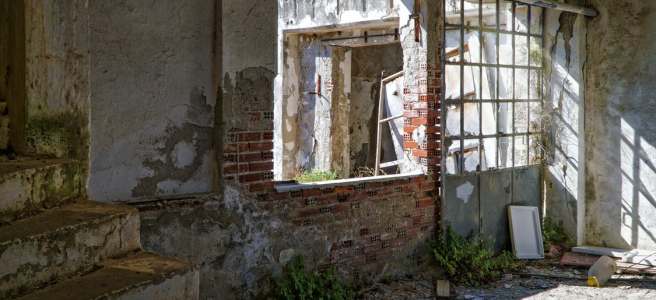
Decomposition in the Body

The Moment Of Death: 

1. The heart stops.
2. The skin gets tight and ashen in colour.
3. All the muscles relax.
4. The bladder and bowels empty.
5. The body temperature begins to drop ½ degrees Centigrade per hour.

After 30 minutes: 

6. The skin gets purple and waxy.
7. The lips, fingernails, and toenails fade to a pale colour.
8. Blood pools at the bottom of the body.
9. The hands and feet turn blue.
10. The eyes sink into the skull.

After 4 hours: 

11. Rigor mortis starts.
12. The purpling of the skin and the pooling of the blood continue.
13. Rigor continues to tighten muscles for another 24 hours or so.

After 12 hours: 

14. The body is in full rigor mortis.

After 24 hours: 

15. The body is now the temperature of the surrounding environment.
16. In males, the semen dies.
17. The head and neck are now a greenish-blue colour.
18. The greenish-blue colour spreads to the rest of the body.
19. There is a pervasive smell of rotting meat.

After 3 days: 

20. The gas in the body tissues forms large blisters on the skin.
21. The whole body begins to bloat and swell grotesquely.
22. Fluids leak from the mouth, nose, vagina, and rectum.

After 3 weeks: 

23. The skin, hair, and nails are so loose they can easily be pulled off the corpse.
24. The skin bursts open on many places on the body.
25. Decomposition will continue until the body is nothing but skeletal remains, a process that can take a month or so in hot climates, and two months or more in cold climates, like the UK.

Chapter One, Available…

Please read the first chapter of my first novel. I have not actually finished the story as the beginning is not where you start or finish your writing. It has not been professionally edited and may contain gramatical errors and the like. This is work in progress, as I’m sure you can tell. Comments are very much welcome. →

Chapter One

Crime Fiction Genre Sub-categories

The first one is where I want to be involved, although the second is very, very interesting and I might cut some showing graphic violence in the hard-boiled detective and go with a slight mix with cozy mystery.

  1. In the hard-boiled private investigator genre, the detective works in a city, and the violence is explicit. The detective follows clues in the dark underbelly of the city. Example: Mickey Spillane’s ‘Mike Hammer’
  2. In the cosy mystery genre, the detective is usually an amateur, the violence is never described in detail, and the setting is often a small town. The detective uses his or her powers of observation and deduction, as well as an excellent general knowledge to solve the crime. Example: Agatha Christie’s ‘Miss Marple’ and on TV or movies I prefer the Miss Marple played by Margaret Rutherford.
  3. The legal thriller requires research into the rules and procedures of a legal world. A lot of readers want to know what happens after a crime is committed and an arrest is made. You can use crises of legal conscience to make your characters more rounded. Examples: John Grisham and Richard North Patterson write in this genre
  4. The police procedural is realistic and should be as accurate as the author can make it. The reader is taken to a squad room, morgue, court, and crime scenes. This genre is complicated and the detective is often under a lot of pressure. For example, he or she could be dealing with many cases, he generally has personal problems with relationships, and his superiors want the case solved. There are secondary characters, including suspects, police officers, lawyers, and criminals. Examples: Ian Rankin’s ‘Rebus’, Michael Connelly’s ‘Harry Bosch’, and James Patterson’s ‘Alex Cross’
  5. The medical thriller is a suspense novel that takes place in a hospital. The protagonists are usually doctors or nurses. The plot is based on situations unique to medicine and medical research. Examples: Robin Cook, Michael Crichton and Tess Gerritsen write in this genre.
  6. The forensic thriller is a fairly new genre. The lead character is usually a woman who is a scientist or pathologist. Research is needed. Accuracy is essential. Most of the action takes place in crime scenes and morgues, and in the lead character’s home. Examples: Jeffery Deaver’s ‘Lincoln Rhyme’, Patricia Cornwell’s ‘Kay Scarpetta’, and Kathy Reichs’s ‘Temperance Brennan’
  7. The general suspense thriller features a protagonist who is generally thrown into the action in the aftermath of a crime. This hero is often an ordinary person who is called on to solve a problem. Sometimes, this person must prove his or her innocence, often to the police and other characters in the novel. Examples: Lee Child’s ‘Jack Reacher’; Gillian Flynn and Dennis Lehane also write in this genre.
  8. The Military Thriller has a protagonist who is often a member of the military, MI5, the CIA or the FBI, or a consultant to a military agency. Readers of this genre love the details and a lot of research is necessary. Often the criminals are crooked politicians or terrorists. The action often spans continents. Example: Tom Clancy’s ‘Jack Ryan’ which has been a favourite of mine for many years.

Tenses

Different Tense in Novel Writing

Simple Past Tense

Simple past tense is used to narrate an action of the past. The verb in the past tense ends with an ‘-ed’ and hence, there are seven ways of marking the irregular verbs in the past tense. The most common being the change of the vowel as in ‘drink’ – ‘drank’.

Construction

Subject + Verb + Object

Examples:

  • Brian worked in that office for almost eight years.
  • She passed away in 1999.
  • We went for the movie yesterday.
  • Two years ago, I studied at the Leeds University.

Past Continuous Tense

This from of tense indicates activities that have already happened in the past and have been completed before the time of mention. These sentences are formed with the help of an auxiliary verb and giving the main verb an ‘ing’ ending.

Structure 

Subject + Was/Were + Verb in its -ing form + Object

Examples:

  • She was washing the dishes, while he was cooking dinner.
  • was working at 1p.m yesterday afternoon.
  • We were playing football when it started to rain.
  • He was reading a thriller novel when I called him.
  • What were you doing when Tom arrived?
  • was walking down the street yesterday when the police car was patrolling the town.

Past Perfect Tense

This tense refers to a non-continuous action that was already completed in the past. Such sentences are formed by using the Simple Past form of the auxiliary verb ‘to have’, followed by the past participle form of the verb.

Structure 

Subject + Had + Past Participle form of Verb + Object

Example:

  • had never seen such a beautiful  horse before.
  • He understood the movie only because he had read the book.
  • Cara had never been to a pub before last night.
  • We didn’t get a room in the hotel because we had not booked in advance.

Past Perfect Continuous Tense

A continuous action that was completed sometime in the past falls under Past Perfect Continuous tense. Such sentences are framed by using the modal, ‘had’ + ‘been’ + the present participle of the verb (-ing).

Structure:

Subject + Had + Been + Verb (ing) + Object

Example:

  • had been playing the piano all morning.
  • had been sleeping all the way from the beginning of the lecture.
  • He had been trying to call her.
  • Until this year, Lucy had been going to a village school.
  • The baby had been crying out loud for minutes when her mother fed her.

She said, he said. Tags

Common errors and examples of correct dialogue in sentences:
Wrong: “Hope you’ve seen the video, Ken,” He said.
Wrong: “Hope you’ve seen the video, Ken.He said.
Wrong: “Hope you’ve seen the video, Ken.” he said.
Correct: “Hope you’ve seen the video, Ken,” he said.
Wrong: “Jill is seven years old now,” Dad said, “But she needs a new school soon.”
Wrong: “Jill is seven years old now,” Dad said. “but she needs a new school soon.”
Correct: “Jill is seven years old now,” Dad said, “but she needs a new school soon.”

If the reader already knows who is talking and the meaning of the dialogue is clear, there’s no reason for an indicating tag. In a lot of scenes, there are two characters talking, and no tags are necessary. If you have to put, “she said angrily” or “she said sarcastically” then your dialogue is feeble.
The terms he said, and she said are known as tags in dialogue. There are unnecessary, illogical and inconsistent uses of tags.

Unnecessary tag:
“I could just shoot you in the head, and I’d be happy to see through a hole in your head, you sick bastard,” she said in anger.

Illogical tag:
“Now I know the phone is ringing, I hear it,” he frowned. – He can not frown in words.

Inconsistent tag:
“I ain’t saying he’s mad, but he’s on his way here with a sawn-off shotgun,” she said struggling to catch her breath.—But she doesn’t appear to have any trouble speaking or catching her breath.

Consistent tag:
“I ain’t. Ain’t sayin’. He…he’s mad…but…he’s…on his way here…with a sawn-off…shotgun,” she said struggling to catch her breath.

Writing dialogue is like editing lines in a movie. Some are weak and need more punch. The dialogue needs to be direct and to the point.

Small talk is undoubtedly crap chatty dialogue:
“Hi Bill, How you today?”
“I’m fine. How about you, Rich?”
“Oh, you know. Things are moving slowly.”
“I know what you mean. Finding a new job is a slow one.”
“How’re the kids?”
“They are teenagers, always difficult.”

Narration, Description and Dialogue
How much of a story should be narration, and description, and dialogue?

Some instructors say it’s a third narration, a third description, and a third dialogue. Then, some say it’s 30 percent narration, 20 percent description, and 50 percent dialogue.—How mutch narration, description, and dialogue is needed in a story is always different to each story. Some excellent stories are mostly dialogue, and some very successful stories hardly have any. Some really crap stories have a perfect balance.

Published Short Story

The short story I wrote earlier this month is published in the Short Fiction Break

Title: My Alien Abduction

Written By: Philip Shepherd

Short stories seem to be a pleasant place to write a 15 minute read into a scene or two of excitement or interest. I my delve into the short story publication arena as I do have many isolated scenes that may have the ability of being published.

Passive Voice Sentences are Bad

Writing in the passive voice is not looked upon as being good for a story. What is a passive and active voice? Further examples will be added.

Present Tense
Active:                                         Passive:
She plays a song.                      A song was played by her.
She does not sing.                    A song is not sung by her.
I am writing a letter.                A letter is being written by me.
I am not writing a letter.         A letter is not being written by me.
Am I writing a novel?                 Is a novel being written by me?

Past Tense
Active:                                             Passive:
She has finished a novel.           Her novel has been finished by her.
I killed a bird.                                 A bird was killed by me.
He was driving a car.                    A car was being driven by him.

Future Tense
Active:                                               Passive:
She will have finished her work. Her work will have been finished by her.
They will have elected him.           He will have been elected by them.

Active:
Subject + will/shall + have + past participle form of the verb + object

Passive:
Object of the active sentence + will/shall + have + been + past participle form of the verb + by + subject of the active sentence


Imagination Manipulation

Imagination manipulation is the workplace of a writer. Manipulation is of particular importance in mystery or crime fiction. The aim of crime fiction is to give all the information to solve the offence while leaving the reader unaware of the solution until the end when it should come as a surprise.
Many techniques can be used to impart information when it is unimportant. When an author looks at each word’s purpose, else if it is not essential, removes it from the novel. Every single word is important in a story.
Submitting my short story to the workshop, I received comments where women thought the protagonist was female and men thought the protagonist was male. You don’t have to explain everything. My favourite book, which I still have from the 1980s is Shogun. Obviously, a lot of the names are Japanese and unpronounceable to me. So, I saw the name, recognised the shape of the word and just referred to them as the first letter and carried on reading.
Someone reading a story brings that story into their own world where they modify it and creates images of the characters, who they are, what they look like, etc. As a writer, you don’t need to go into detail about every person, every scene, especially in a short story and only if that characteristic is relevant to the plot.
I am actually getting to like short stories now. You just get right into the action and strng the reader along.

In a lot of the courses I have done in writing, I have been told, I’m waffling and describing too much. At the time I thought, “Well, War and Peace could be written on the side of an A4 page, never mind the hundreds of pages. What’s going on?” Now I understand, you are giving the reader a scenario with characters, and in a lot of situations like the short story, that’s all you need as they will create the rest in their imagination.
Imagination is a very powerful sense. There should, in all honesty, be six sences—vision, hearing, feel, taste, smell and imagination. The writer narrows down the genre and is aware of what they want and expect. The author is aware of where the genre particular reader’s imagination will take them. In crime fiction, the story must make the solution a surprise until the climax of the story. This is where the writer must manipulate the reader’s imagination. Give really relevant information along with weak stuff or just after other big scenes where there is action, as the reader will be concentrating on what just happened, and vice versa. End of chapters is a good place as the reader may be thinking, “Only one page left in this chapter.” I did enjoy playing with people’s imagination in my short story and then twisting them round at the end. I may produce more short stories as my novel sends me out of my mind.

Short Story Submitted:

Results come out in three to four weeks:

My Alien Abduction

Driving a half hour to work every morning is boring, isn’t it? I was on my way to work on the first Thursday in June. Work is one of those locations where you do something for someone else, and they pay you money. It was a lovely sunny morning, and I took a different route, and now was enjoying the half hour drive through the countryside. The sound of the engine was pleasant to me, but I wanted some music. I turned the stereo on to my CD, and the music of Elvis Presley became evident.

The road was on a hill, and the car experienced some effort to climb, so I decreased the gear and gave it some life. The sound of the music became filtered by the noise of a jet plane that was flying low, and it was loud. The racket of the jet plane was growing louder than my stereo music. The plane must be so low in the sky, so I looked around for it, but couldn’t see it anywhere through my windows. It was strange that I could still hear it. As it was so loud, I stopped on some grass and looked all around the car. I still couldn’t see the jet, and I got out of my car. There was nothing in sight. The noise seemed to be coming from directly above my vehicle. Watching the area of sound, I still couldn’t see anything. There didn’t appear to be anyone else around either. Only when I had looked for thirty seconds or so, that I noticed a shape. It was not solid as it was just an outline in the sky.

I started to become dizzy, so I looked down to the floor for a reference point. Suddenly a black and white image of the grass and road was visible. The growing feeling of fear began to overtake my judgement. I grabbed for my car to help me to keep my balance. My hands went through without feeling anything. The white colour was becoming prominent in my vision. I couldn’t see any images any longer. My stomach turned upside down, and I thought my breakfast was on its way back. Everything was white now, and I couldn’t see my hands, feet or any body part. My head was feeling full of blood, and just like if you were upside down. I had been wearing glasses, but not any longer. My stomach was becoming uncomfortable. I needed to vomit, to end the pain in my stomach.

A spherical object appeared, and it was becoming larger and larger. A second sphere became visible too. The globes approached together, and I began to hear a squeaky sound. It continued for nearly a minute.

I cleared my throat and spoke, “Hello, where… am I? Who are you two? And why can’t I see anything else?”

The squeaking started again but transformed from the high-pitched squeak to a recognisable voice. “We apologise for the slow, deliberate effort in communication. We have been receiving transmissions from this planet, and we analysed a lot of them. This awkward, silly little language is English, yes?”

“Err…That is true. Who are you? Where are we? Also, what’s this white colour all around?” I questioned.

“Your silly English language has no known words to us that describe who we are and the form we take.”

“So, what you want? Am I the right person with which to speak?”

The aliens explained, “Oh dear Lord, seemingly, the protocol for introductions is discourse and then meetings.” There was a pause, and then they resumed, “We have a problem with this rock of yours, and we wish to stop the transmissions that are affecting our society.”

“Oh crap, I, I’m not the right person. You need to speak with leaders and scientists of our planet.” I was getting used to the white background and my stomach, although feeling rough I had it under control. The fear was still there, but I was now aware of the situation.

“The electromagnetic transmissions from this rock are interfering with the lifestyle on our planet, and we must rectify that situation.”

I frowned and took a deep breath and said, “How is it disrupting the life on your planet?”

“We use electromagnetic frequencies for communication from individual to individual. On the reception of the transmissions from your planet, a break in our connection occurs, and it makes general miscommunication likely.” The globes changed colour and turned a dark red. “Your projections are damaging our society. We must stop you from broadcasting the omissions that affect our lifestyle. We may have to destroy this planet.”

Fear within me began to rise for myself and the planet Earth. “Alright, we need to get out of here and talk with our leaders and scientists. I’m sure we can come to some joint agreement, and there is no need for any disruption on either of our planets, ok? Where is your planet?” I asked.

The aliens responded, “Speed and distance travelled may be helpful, as we cannot point to it or have knowledge of your star charts. The concept of time demands the knowledge of the counting of the electromagnetic waves. You are a different life form we have come across within this atmosphere. We tried to talk with you, and we had to apply some tests to the number of electromagnetic cycles you could detect, both visually and audibly. Other life forms on this planet have different detection ranges.”

“Have you been speaking with animals?” My mind was thinking about communication with the rest of the life on Earth. “What did they say?” I was getting interested in their communication to other lifeforms and saving our planet. “Ok, distance. The only speed that is constant is light. Are you aware of that speed?”

“I certainly think so, as light is an electromagnetic wave and we use it. But, you are only conscious of a narrow band, and we can move into the range in which you can identify us,” insisted the extra-terrestrials.

“So, what percentage speed of light wave did you travel, and how long was your journey?” It did feel ridiculous talking with two spheres inside an entirely white zone. So, I mentioned, “Are you able to exit your starship?”

“You are presently on our vessel, and we could alter its electromagnetic wave frequency so your lifeform may recognise our identity. We transported you to our starship and created an atmosphere that sustains your life,” explained the aliens.

“So, so if you move me outside again and follow me, I could, could take you to the people with whom you should be talking.”

“Agreed, we will transport you and create the electromagnetic waves so we can continue to impart knowledge within your so limited frequency waveband.”

I was a little happier and replied, “Alright, let’s go.” Once again, the whiteness blinded me during the experience. Gravity came back and so did the ground, my arms, legs and glasses. I looked around and still didn’t see their starship. Above my car, an object started to become visible. It was about the size of a coconut.

There was also a voice I could hear, “On our journey to your planet, we have stopped receiving interference. We have been travelling for five of your years.”

“I have recently bought a satellite receiver, and this is enabling the closure of many low-frequency ground broadcasts. Perhaps, those were the source of the interference, and we are stopping their use as our technology improves.”

“That is a possibility, and we will speak about this with your scientists.”

“You do have a lot of knowledge about our planet Earth.”

“Yes, we have been receiving your interference for many of your years. We would like to meet the leading scientist of your planet—Doctor Sheldon Cooper.”

“Doctor who?… Hang on a minute, where did you hear that name?”

“The mentioning of Doctor Sheldon Cooper was almost every time we analysed the waveform interference. It also appeared to contain a lot of scientific terms.”

“Do you also recognise the words—The Big Bang Theory?”

“Yes, that was all over your interference. Hopefully, we won’t meet the evil Wil Wheaton.

“Oh no, there will be a lot of explaining about the interference you have been analysing.”

“Are you feeling fear? Do you need us to sing the Soft Kitty to you?”

Hyphens & Dashes

em-dash-vs-en-dash

HYPHEN

Hyphens are used to break single words into parts, or to join ordinarily separate words into single words.

Example: Son-of-a-bitch.

EN-DASH

The EN dash is commonly used to indicate a closed range of values.

Example: 2:00–6:00 pm. For ages 10–16 years of age.

EM-DASH

EM Dashes are used to indicate a break in thought or sentence structure, to introduce a phrase added for emphasis, definition, or explanation, or to separate two clauses and avoid a comma splice.

Example: Clearly, I can do it—as long as I’m in range. I know what I’m doing—been doing it for years.